The world of internet memes is vast, colourful and constantly changing. New formats appear every week, most of them forgotten within a month. A few survive for years, and Wojak is one of them.
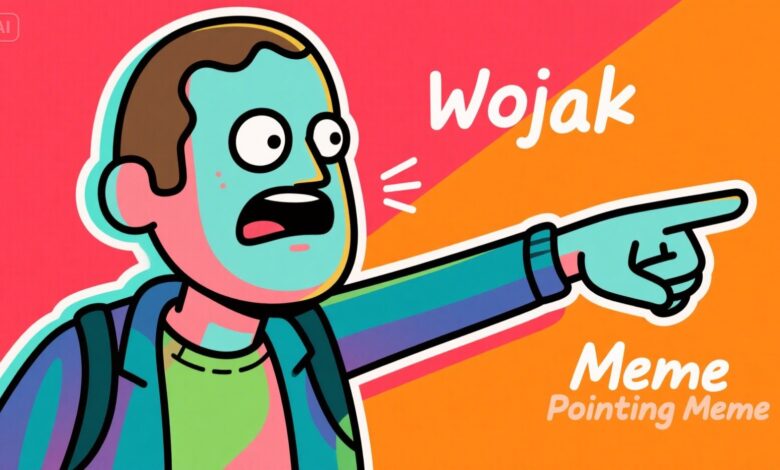
Wojak — the crudely drawn, bald, melancholy figure also known as “Feels Guy” — has been redrawn into hundreds of variations since the early 2010s. One of the most durable is the Wojak pointing meme: a simple image of Wojak pointing at something or someone, usually with an expression of surprise, recognition or dawning realisation. It has become a shorthand for a whole set of social reactions, from “that’s literally me” to “look who’s talking.” This guide explains where it came from, what it means, why it keeps working, and how to make your own.
1. What Is the Wojak Pointing Meme?
The Wojak pointing meme typically shows the familiar Wojak character — a minimalist, hand-drawn face with a bald head and a long, expressive mouth — pointing at another Wojak, a person, an object, an event or a caption. The gesture does most of the work. Pointing is one of the most basic human signals: it says “look at that”, “that one”, or “you”.
Depending on the caption, the same image can mean several different things:
- Recognition: “That’s me.” One Wojak points at a description of a habit, fear or personality trait the poster identifies with.
- Accusation: “Look who’s talking.” One Wojak points at another who is guilty of exactly the thing they are criticising.
- Realisation: “Wait — that’s the same thing.” The pointing marks the moment two apparently different things turn out to be identical.
- Shared experience: “I see you.” The gesture signals that the viewer is not alone in a frustration, embarrassment or guilty pleasure.
The drawing style matters too. Wojak is deliberately rough and simple, which makes the image feel honest rather than polished — as if it were sketched by someone who feels the same way. That roughness is part of the appeal, and it makes the template easy to edit: anyone can add a caption, swap a face, or combine it with another character.
2. Origins: From “Feels Guy” to Pointing Wojak
Wojak originated in the early 2010s on imageboards, first associated with the German board Krautchan and then spreading to 4chan, Reddit and other meme hubs. The original drawing showed a melancholy man, and it was used to express feelings that were hard to put into words: loneliness, awkwardness, disappointment, quiet empathy. That is where the nickname “Feels Guy” came from.
Over time, the character escaped that single mood. Artists and anonymous posters redrew Wojak in countless situations — Wojak at work, Wojak on a date, Wojak arguing online, Wojak celebrating, Wojak giving up. Each version kept the same basic face but changed the context, turning a symbol of sadness into a flexible tool for social commentary.
The pointing variation emerged from that evolution. It combined Wojak’s expressive face with one of the oldest gestures in human communication, and the result was immediately useful: a picture that could call something out, identify with something, or expose a contradiction, all in a single frame. Because the image is so simple, it travelled fast across platforms — Reddit, Discord, Twitter/X, Instagram and group chats — and it is still in regular use years later, which is a long life for any meme.
3. Why Is the Wojak Pointing Meme So Popular?
Four qualities explain why this particular format has lasted while thousands of others faded.
Relatability. The meme works because it expresses emotions and social dynamics almost everyone recognises: the moment you catch yourself doing the thing you criticise in others, the realisation that a stranger’s complaint is exactly your own, the urge to point out hypocrisy without writing an essay. People share it because it says something they already feel.
Simplicity and versatility. The minimalist art style means the image can be adapted to any topic — work, dating, politics, gaming, money, health — without losing its impact. The caption does the specific work; the picture supplies the tone. A format that can carry any joke will be used for every joke.
Combination with other memes. The pointing Wojak is often combined with other characters and templates: a Wojak pointing at a Chad, a “doomer” Wojak pointing at an “NPC” Wojak, two Wojaks pointing at each other to show two sides of the same argument. These combinations create layered humour that rewards people who know the wider meme vocabulary, while the basic gesture stays readable even to newcomers.
Visual impact. Pointing draws the eye. The extended arm and finger create a line that leads the viewer straight to the caption or the second character, so the joke lands in a fraction of a second. In a feed where every post competes for attention, an image that directs your gaze is an advantage.
4. Common Uses and Examples
Across Reddit, Discord, Twitter/X and Instagram, the pointing Wojak appears in a handful of recurring patterns:
- Self-identification. A Wojak points at a caption describing a relatable trait: “me, staying up until 3 a.m. reading about a topic I will never use”, or “me, saying I’ll start the diet on Monday.” The joke is recognition, and the comments are usually full of people agreeing.
- Calling out hypocrisy. One Wojak points at another who is doing exactly what they just condemned — the classic “pot calling the kettle black” setup, compressed into a single image.
- Depicting shared experiences. The gesture communicates “I see you” or “me too” about a common frustration: long queues, awkward small talk, the last slice of pizza. The humour comes from the feeling of being understood.
- Political and social commentary. The format is regularly used for satire, with one Wojak pointing at a contradictory statement or policy. Because the image itself is neutral, it can be pointed in any political direction, which is part of why it survives: no side owns it.
- The “two Wojaks” standoff. Two Wojaks point at each other, each representing a contradictory opinion or a group accusing the other of the same fault. It is a compact way of saying “both sides are doing this”, and it is one of the most reused variants.
A typical example: one Wojak, labelled “me explaining why I’m broke”, points at another Wojak labelled “also me, buying a third coffee today”. No further explanation is needed — the contradiction is the joke.
5. The Wojak Pointing Meme in Meme Culture and Beyond
Beyond simple humour, the pointing Wojak has become a small piece of internet language. It reflects how online communities use jokes to process complicated feelings: embarrassment, loneliness, frustration with institutions, the sense that everyone is pretending. A crude drawing of a man pointing can say “I know that feeling” more efficiently than a paragraph, and that efficiency is why it keeps circulating.
The format has also influenced how people communicate outside meme spaces. The “pointing” gesture has been adopted in reaction images, video edits and even marketing, because it borrows the same instant readability. Creators remix the template with modern contexts — new characters, current events, fresh slang — which keeps it relevant rather than frozen in the era when it was born.
That constant remixing is the real secret of its longevity. A meme that can only mean one thing dies when that thing stops being topical. A meme that can mean recognition, accusation, irony or solidarity can be reused indefinitely, because there is always something new to point at.
6. How to Create Your Own Wojak Pointing Meme
Making one is straightforward, and you do not need professional tools:
- Find a template. Free Wojak pointing templates are widely available on meme generator sites and imageboard archives. Alternatively, sketch your own — the rough style is forgiving, and a hand-drawn version can be funnier than a polished one.
- Choose a clear, relatable caption. The message should be short and specific. “Me, pointing at the thing I said I would never do again” works better than a long explanation. Think about something your audience will recognise in themselves.
- Keep it to one idea. The best pointing memes make a single point. If the caption needs two sentences, it is probably two memes.
- Use simple editing tools. Photoshop, GIMP, free phone apps, or any online meme generator can add text and crop the image. White text with a black outline is the traditional choice because it stays readable on any background.
- Share responsibly. Follow the rules of the community where you post, and be careful with sensitive topics. A meme that punches down at a real person or group will usually backfire, and some platforms remove content that targets individuals.
Frequently Asked Questions
What does the Wojak pointing meme mean?
It depends on the caption, but the gesture generally signals recognition, accusation or ironic identification — “that’s me”, “look who’s talking”, or “those two things are the same.”
Where did Wojak come from?
Wojak, or “Feels Guy”, originated in the early 2010s on imageboards such as Krautchan, then spread to 4chan and Reddit. The pointing variation came later, as the character was redrawn into many different situations.
Why is Wojak drawn so crudely?
The rough, minimalist style is part of the appeal: it feels honest and unpolished, it is easy to copy and edit, and it lets the emotion carry the image rather than the artwork.
Is the Wojak pointing meme still popular?
Yes. Because the format is simple and can be applied to any topic, it continues to circulate on Reddit, Discord, Twitter/X and Instagram years after it first appeared, with new captions keeping it current.
Can I use the Wojak pointing meme commercially?
Wojak images are user-generated and widely remixed, but their exact legal status is unclear and there is no single rights holder to ask. For commercial use, it is safer to create an original illustration in a similar style than to reuse a template you found online.
The Bottom Line
The Wojak pointing meme has lasted because it does something very simple very well: it takes a universal gesture — pointing — and pairs it with a face that everyone recognises as “someone who feels this too.” In one small image it can say “that’s me”, “look who’s talking”, or “we are all doing the same thing.” As digital communication keeps evolving, formats like this remind us that the most durable jokes are rarely the most complicated ones. They are the ones that name a feeling everyone already has, and point straight at it.